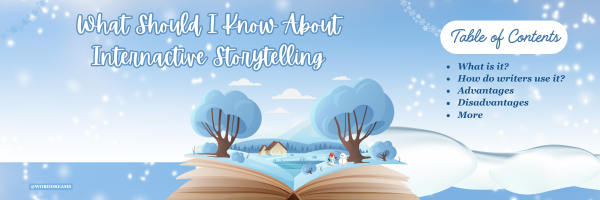
Here's what I cover: - What is it?
- How can writers use it?
- Advantages
- Disadvantages
Interactive storytelling is a growing trend that allows readers to actively participate in shaping the narrative. With advancements in augmented and virtual reality,
stories are no longer confined to the pages of a book. Authors can provide immersive experiences and create narratives that respond to reader choices. Interactive storytelling allows the audience to actively shape the story rather than passively consume it. Unlike traditional storytelling with a fixed plot, interactive stories let users influence the direction, outcomes, and details through their choices and input. It blends creativity with technology, making each telling
unique. 81% of marketers agree interactive content grabs attention more effectively and 66% admit it increases audience engagement. I can attest to this popularity. As a teacher, I occasionally asked students to choose from among several story endings or create their own. A good example is Mission
USA, a website that uses interactive storytelling to teach historic events such as the American Revolution, Civil Rights, the Great Depression, and more: Click for more Every year, the United Nations recognizes April 22nd as International Mother Earth Day. It is a day we can all participate in making our air clean, water fresh and land unlittered rather than accepting the trash-filled oceans, the smoggy skies, and the debris-laden land that is
becoming the norm. Despite the questionable health of our world, we have made progress. Back in 1970, when Earth Day was first celebrated, trucks spewed black smoke as they drove down the highways, toxic waste was dumped into oceans with no repercussions, and the general opinion was that the Earth took care of itself. That changed when U.S. Senator Gaylord Nelson, Earth Day's founder, witnessed the ravages of the 1969 massive oil spill in Santa Barbara California and decided
it was time to do something. He started with a “national teach-in on the environment” with a simple goal: Encourage people to recognize the importance of protecting the Earth: "It was on that day [Earth Day] that Americans made it clear they understood and were deeply concerned over the deterioration of our environment and the mindless dissipation of our resources."
Before I go any further, listen to Earth's song, recorded by NASA in space. It is
stunning: Military academies offer benefits most high school students and their parents don't realize: - the quality of education is comparable to an Ivy League
- they not only provide you with an education, but provide a job when you finish--no job hunting, no rejections,
- they
pay you to go to school--that's right, each of the four years, you are paid more to attend classes and complete the other activities required to graduate
- they are free--no charge for classes, books, room and board; they even pay for your summer school
But they are picky. Applying pits you against a huge pool of highly-qualified applicants. It's not just about who has the best GPA and SAT scores. Admissions
weighs: - scholastics
- physical
- moral
- personal drive
To gain acceptance requires something different than the usual preparation. Here's one book to prepare you: Click for more In process, on my writer's blog, WordDreams, my wonderful efriends are helping me launch my latest prehistoric fiction, Badlands. Early reviews... "Your best ever"--husby (you say he said the same thing last time? I don't remember) "...prehistoric man takes on nature in all her fury and survives." --Sandra
Cox Click for more: |
Questions? Go ahead and ask! I love tech ed questions. You can either reply to this newsletter or contact me via email. |
|